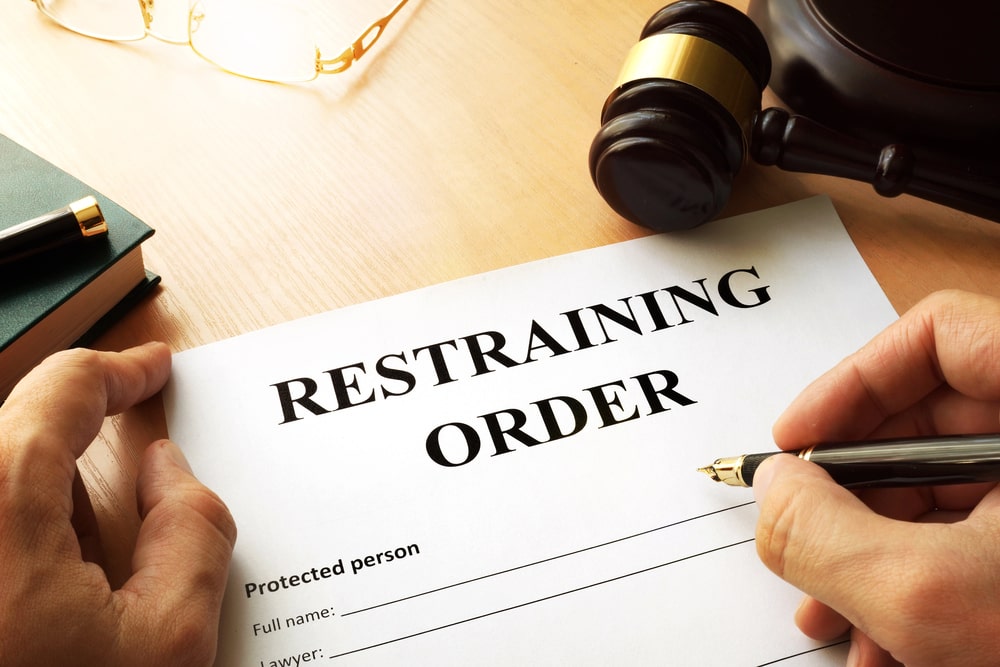
A restraining order is an order from the court that prohibits an aggressor from harassing, stalking, abusing, or threatening a victim. If you are seeking or have a restraining order against you, you want to know about California restraining orders. This includes what they are, the types available, the legal process for obtaining a restraining order, and the serious consequences if you are the restrained person.
These legal protections are based on key California statutes, principally the Domestic Violence Prevention Act, contained in the California Family Code Section 6200, and the Code of Civil Procedure Section 527.6, which covers civil harassment. Whether seeking or having received a restraining order, the guidance of a restraining order lawyer is paramount. Contact our experienced restraining order lawyers at Goldman Flores Restraining Order Law Firm for legal counsel in San Diego, CA.
What a California Restraining Order Legally Does
When confronted with threats, harassment, or abuse, knowing the specific, tangible protections a court can provide is the first step in ensuring your safety. A restraining order is a legally enforceable court order that strictly limits another person's behavior. These directives are not one-size-fits-all but are tailored to your specific situation through several orders.
The order aims to create a legal barrier to prevent further harm. If that barrier is crossed, it can lead to immediate legal consequences for the restrained individual, including possible arrest and criminal charges.
The most common components of a restraining order are:
Personal Conduct Orders
A personal conduct order is often the core of a restraining order, as it addresses and forbids the behaviors that led you to seek protection in the first place. This type of order prohibits the restrained person from doing a wide variety of things concerning you and, in many cases, your family or household members. It is a comprehensive "no contact" rule by the court.
This means the restrained person cannot assault, threaten, stalk, or harass you. The prohibition is not limited to physical actions but includes all forms of communication. You will find that this order prohibits the restrained person from:
- Calling you
- Sending text messages or emails
- Contacting you through social media platforms
- Using any other means to communicate with you, directly or indirectly, through another person
The goal is to cut off all lines of unwanted contact so you have the peace and security to move on without fear of further intimidation or abuse.
Stay-Away Orders
While a personal conduct order bars certain behaviors, a stay-away order establishes a physical safety zone around you. This order legally obliges the restrained person to keep their distance from you and specific places related to your daily life. Typically, this distance is set at 100 yards, although a judge can change it depending on the circumstances of your case.
This means that the restrained person is legally prohibited from coming within that specified distance of:
- You
- Your home
- Your place of work
- Your children's schools or childcare facilities
- Your vehicle
A stay-away order aims to prevent the restrained person from having physical proximity to harm, intimidate, or spy on you. It turns your key locations into legally protected areas so you can conduct your day-to-day routines with more security, knowing that an enforceable boundary is in place.
Residence Exclusion ("Move-Out") Orders
Under the condition of domestic violence, when you and the abuser live together in a house, the court may issue a residence exclusion order, which is also referred to as a "move-out" order. A strong and direct protection is legally obligatory to get the restrained individual out of the shared home, even though the title or lease is in their name. You can be granted exclusive use and possession of the residence.
A judge will only make this type of order if there is sufficient evidence of physical violence or a substantial threat of violence. The order grants law enforcement the right to take the restrained person off the property.
This measure is designed for immediate safety and stability for victims of domestic violence and children, eliminating the immediate threat within the home environment and giving you control over your living space while you navigate the next steps.
The Four Main Types of Restraining Orders
California law recognizes that threats and harassment can be based on different relationships and situations. The legal system has created four restraining orders, each designed for a specific context to address this. Choosing the correct type of order is a critical first step, as the relationship between you and the other person will determine which statute applies to your case.
Regardless of whether an intimate partner is abusing you, harassing you by a neighbor, an elderly family member is being abused, or you are threatened in your job, there is a particular legal tool that is ready to offer protection. Knowing these categories will help you file the proper petition and adhere to legal standards to ensure your safety.
Domestic Violence Restraining Order (DVRO)
The Domestic Violence Restraining Order is specially intended to ensure that you are not abused by a person with whom you have a close relationship. This is one of the relationships broadly characterized by California's Domestic Violence Prevention Act.
You can apply for a DVRO if the person who is causing you harm is a current or former spouse, a domestic partner, someone you are dating or used to date, a person with whom you have a child, or a close family member such as a parent, sibling, or in-law.
The abuse does not have to be physical violence. A DVRO may be granted on evidence of stalking, threatening, harassing, destroying personal property, or disturbing the peace. Such an order can be up to five years and involve child custody, visitation, and child or spousal support.
Civil Harassment Restraining Order (CHRO)
When you are feeling harassed, threatened, or stalked by an individual who does not qualify as a domestic violence victim, such as a neighbor, a roommate, a colleague, or a stranger, you would apply for a Civil Harassment Restraining Order (CHRO). The Code of Civil Procedure of California Section 527.6 controls this kind of order.
To secure a CHRO, you must prove to the court that you have been the target of clear and convincing evidence of harassment, a course of conduct that seriously alarms, annoys, or harasses you, and is not justified by any legitimate purpose. This could include unlawful violence or a credible threat of violence.
Unlike a DVRO, the standard of proof is higher, and more than just a likelihood that the harassment occurred is required. A CHRO can order the restrained person to stop the harassment and stay away from you for up to 5 years.
Elder or Dependent Adult Abuse Restraining Order
This special restraining order is used to protect one of the most vulnerable populations in the state. An Elder or Dependent Adult Abuse Restraining Order is intended to protect people 65 years of age or older or dependent adults between 18 and 64 years of age with specific disabilities from abuse. The abuse under this order is broad and not limited to physical harm, neglect, or abandonment, but also financial abuse, as seniors are a common target of financial abuse.
The order can be requested by the elder or dependent adult or by a conservator or agent acting on behalf of the elder or dependent adult. If granted, the order can prohibit the abuser from contacting the individual, order them to stay away, and, in cases of financial abuse, can include orders to protect the individual's property and assets.
Workplace Violence Restraining Order
A Workplace Violence Restraining Order is unique because the victim does not file it, but an employer files it on behalf of an employee. An employer can seek this order to protect an employee from unlawful violence or a credible threat of violence that has occurred at the workplace. The goal is to create a safe working environment for all employees.
To get this order, the employer must prove that the employee has been severely harmed or is in danger of being hurt. The order may prevent the restrained person from entering the workplace and contacting the protected employee if granted. These orders may take up to three years and are very necessary as employers have a duty to provide a safe and secure workplace.
How to Obtain a Restraining Order
Navigating the court system to get a restraining order can be intimidating, but the process is organized and meant to offer protection quickly when necessary. Different and logical steps exist between the first request and getting a long-term order. It starts with an emergency measure to ensure you are safe right away, and then a formal court hearing where a judge listens to evidence from both sides and decides.
This three-step process of moving the temporary order into the court hearing and the permanent order may be demystified by understanding this process and taking a decisive step to protect yourself and your loved ones.
Step 1: The Temporary Restraining Order (TRO)
The first step in getting legal protection is requesting the court issue a Temporary Restraining Order, often known as a TRO. This is an emergency measure to give immediate protection from harm. You can apply for a TRO by completing and filing paperwork with the court that outlines the abuse or threats that you have experienced. A judge will hear your request immediately, sometimes the same day you submit it.
This initial ruling is an ex parte decision, meaning the judge listens to your side of the case without listening to the other party. If the judge feels that you are at risk of being injured soon, they will issue the TRO, which will become effective upon legal service to the other individual. TRO is not a permanent solution; it is a temporary order, which, in most cases, should be of a duration of three weeks, until a formal court hearing can be conducted.
Step 2: The Court Hearing
The scheduling of a formal court hearing follows immediately after the issuance of a TRO. This hearing is the most crucial step in the process, and a judge determines whether to issue a long-term restraining order. Unlike the initial ex parte decision, you (the petitioner) and the person you seek protection from (the respondent) have the right to be present and heard.
During the hearing, you will get an opportunity to lay your case before the judge. This includes giving testimony and submitting evidence to support your claims, such as photographs, text messages, police reports, or medical records. You can also get witnesses to testify on your behalf.
The respondents are also given an equal chance to give their testimony and witnesses as to why the restraining order should not be issued. The judge will hear both sides and thereafter will provide a final judgment.
Step 3: The Permanent Restraining Order
After hearing from both parties and viewing all the evidence, the judge will decide. If the judge finds enough evidence of abuse or harassment, they will issue what is commonly called a "Permanent Restraining Order." Understanding that "permanent" can be misleading in this context is essential. In California, these restraining orders are granted for a limited period of up to five years.
This long-term order supersedes the temporary one and contains specific protections the judge feels are necessary, such as no-contact and stay-away orders. Towards the end of the five years, in case you continue to believe that you are in danger, you may request the court to renew the restraining order for a period of five years, or possibly permanently, without the need to demonstrate any additional cases of abuse.
Understanding the Consequences of a Restraining Order
Although a restraining order is necessary to protect the victims, it is also a legal measure with far-reaching and significant implications for the person to whom it is applied. When you have received a restraining order, you need to understand that this is not a command to go away and leave someone, but a court order that may alter your life significantly and deprive you of certain civil rights.
Breach of any of the terms of the order is a criminal offense that may lead to fines and jail. In addition to the direct legal consequences, a restraining order can impact your right to possess a firearm, your relationship with your children, and even your right to work or live. Recognizing the seriousness of these consequences is the first step in reacting appropriately and safeguarding your rights.
Loss of Firearm Rights
The fact that the right to own or possess firearms is absolutely denied to you is one of the most immediate and serious effects of having been the victim of a restraining order in California. According to state and federal law, any individual subject to a qualifying restraining order cannot possess, own, purchase, or even attempt to purchase any firearm or ammunition. This is not a discretionary penalty but an automatic and mandatory prohibition that applies as soon as the order is in effect.
California Penal Code section 29825 makes it a crime to violate this rule. If you have a restraining order against you, you must give up any firearms you own, usually by selling them to a licensed dealer or turning them over to law enforcement. Failure to do so is a distinct criminal offense with harsh penalties.
Effect on Child Custody and Visitation
A restraining order, particularly a Domestic Violence Restraining Order (DVRO), may have a devastating effect on the child custody and visitation rights when there are mutual children. The court's first and foremost concern is always the best interest of the child, and California law takes findings of domestic violence very seriously in this context.
Under California Family Code section 3044, if a judge has determined that you have committed domestic violence within the last five years, there is a "rebuttable presumption" that you would be unfit for joint or sole custody of your child because it is not in his or her best interest. This means the court begins with the assumption that you should not have custody.
While this presumption can be overcome, the burden of proof is on you to convince the court that an award of custody or visitation would be in your child's best interest, a standard that can be very difficult to meet.
Troubles with Background Checks
Restraining orders are public records published in a statewide law enforcement database called the California Law Enforcement Telecommunications System (CLETS). This means that a restraining order against you can show up on background checks done for various reasons, including employment and housing. Although an employer or a landlord cannot legally discriminate against you because you have a restraining order, the presence of the order can create issues.
A potential employer may wonder whether you are fit for a job, especially if it requires you to interact with the public or work in a sensitive environment. Similarly, a landlord might be reluctant to rent to someone with a restraining order on their record because of concern for the safety of other tenants. These real-life consequences can lead to significant and lasting barriers in your professional and personal life.
Penalties for Violation of a Restraining Order in California
Flouting the terms of a restraining order is a criminal offense in California. You must comply with all the order conditions once a judge has made a lawful order. Under California Penal Code 273.6, any restraining order violation can result in your arrest and criminal prosecution.
Even seemingly minor violations, such as sending a single text message or making a short phone call, are taken seriously by law enforcement and the courts. A violation turns the situation from a civil issue to a criminal one, thus creating a new and separate legal problem with severe penalties, including the possibility of jail time and a permanent criminal record.
To convict you of violating a restraining order, a prosecutor must prove four things beyond a reasonable doubt:
- A court issued a lawful restraining order
- You knew that the restraining order existed
- You were able to follow the terms of the order
- You willfully violated one or more order conditions
The term "willfully" in this context simply means you acted on purpose or intentionally; it does not mean you had to have had any intent to break the law.
The penalties for violating a restraining order depend on the circumstances of the offense. The charge is usually a misdemeanor for the first-time violation that does not involve any violence. A conviction can carry penalties of up to 1 year in county jail, a fine of up to $1,000, or both.
But in the case of the violation being an act of violence or a prior conviction for breaking a restraining order, the consequences are far more serious. In such instances, the crime is a wobbler; therefore, the prosecutor may prosecute the crime as a misdemeanor or a felony. If you are convicted of a felony violation of a restraining order, you may be sentenced to up to three years in state prison and much higher fines.
Find a San Diego Restraining Order Lawyer Near Me
Restraining orders are potent and vital legal tools for personal safety. These are placed under an order of organized trial proceedings that have clear rules. Restraining orders are a shield against harassment and abuse, which gives those who need protection an enforcement order. Those responding to an order have severe, life-changing consequences requiring a strategic legal response.
The challenges of proving your case, meeting the correct standard of evidence, and the complexities of a formal court hearing make representation by a lawyer invaluable. Attempting to manage this process alone puts you at significant risk, no matter your side. For expert legal representation in San Diego, CA, contact Goldman Flores Restraining Order Law Firm at 619-943-4400.